


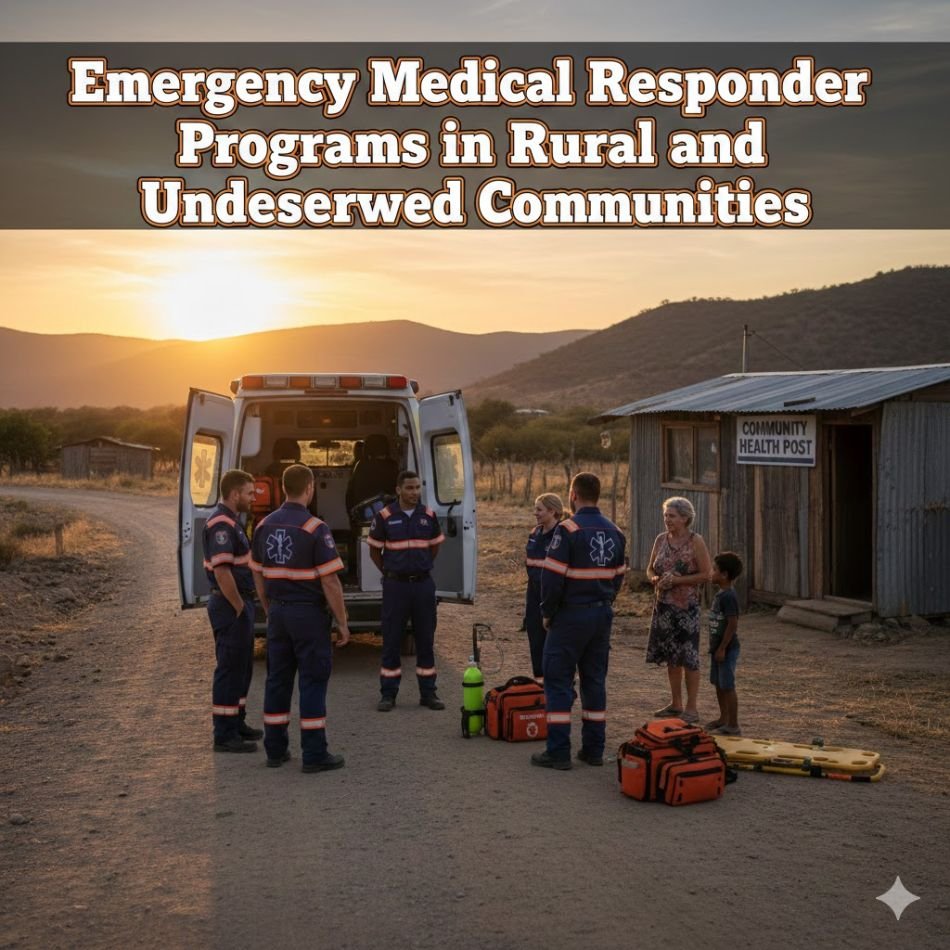
Imagine you live in a small town surrounded by farmland and rolling hills. You’re miles away from the nearest hospital, and the ambulance station is in the next county. If you call 911, how long will it take for help to arrive?
For millions of people living in rural America, that wait can be 30 minutes or longer. In an emergency, every second matters. That’s where emergency medical responder programs step in to fill the gap. These programs train everyday people—neighbors, volunteers, and local health workers—to provide lifesaving care before professional paramedics can reach the scene.
In this article, we’ll explore how these programs work, why they matter more than ever, and what communities are doing to keep them strong.
Life in the country offers peace, but it also comes with real risks when it comes to medical emergencies. The challenges fall into a few main categories.
In cities, an ambulance can often arrive in about eight minutes. In rural areas, the wait stretches to 28 or even 30 minutes on average. When someone stops breathing or has a severe bleed, those extra minutes can mean the difference between life and death.
Rural ambulance crews cover enormous territories. Some services in places like Missouri’s Washington County respond to calls across 1,600 square miles. From some parts of that area, it takes two full hours just to reach a trauma center .
Rural ambulance services operate on tight budgets. Unlike city services that can rely on a large tax base, rural agencies often depend on a mix of grants, donations, and user fees . Many serve a higher percentage of Medicare and Medicaid patients, and those government programs don’t always cover the full cost of a trip.
The result? About 2.3 million people in rural counties live in what experts call “ambulance deserts”—areas where emergency services are stretched dangerously thin.
Rural EMS agencies rely heavily on volunteers. But the pool of willing volunteers is shrinking. Rural populations are aging, and younger people often move to cities for work.
Those who do sign up face long hours, extensive training requirements, and exposure to traumatic situations. One paramedic described how new providers must learn to compartmentalize their emotions when facing terrible scenes—something that can’t be taught in a classroom. The stress leads to burnout, and many rural services become “stepping stones” where people train before moving to better-paying city jobs .
Given these challenges, communities are getting creative. Emergency medical responder programs come in many forms, but they share a common goal: putting trained people in a position to help as quickly as possible.
Emergency medical responders are often the first trained person to arrive at a scene. They might be volunteers, community health workers, or even students. They learn basic lifesaving skills like CPR, bleeding control, and how to use an automated external defibrillator (AED).
These programs don’t replace ambulances. Instead, they bridge the gap between the moment something happens and the moment professional help arrives.
In some parts of the world, community health workers serve as the backbone of emergency response. In Uganda, for example, workers like Israel Katumba travel by bicycle to visit families in their villages. They carry blood pressure machines, referral forms, and tablets to connect with the health system. For the people they serve, they are more than medical providers—they are trusted neighbors.
These workers test for malaria, guide families through immunizations, and connect people to ambulances when emergencies happen. They also go door to door during disease outbreaks to share information about prevention.n
Across the United States and around the world, communities are testing new ways to strengthen emergency medical responder programs. Here are some of the most promising approaches.
Iowa has launched a groundbreaking program called United First Aid. Currently running as a pilot in three counties, the program trains community volunteers to provide immediate help while EMS teams are on the way .
Each participating county receives $50,000 in grant support and ten fully equipped “Go Bags” containing AEDs, tourniquets, and Stop the Bleed kits. The program also provides training and helps connect volunteers with dispatch systems so they’re alerted when someone nearby needs help.
Lt. Governor Chris Cournoyer put it simply: “Rural communities deserve the same access to rapid emergency care as any other community”.
Wisconsin faced a sharp drop in its EMS workforce—a 24% loss over six years. To address this, the state launched Student Emergency Response Team (SERT) programs in high schools.
Students learn emergency preparedness skills and connect with mentors in the field. By training young people early, the program aims to build a pipeline of future first responders. This approach is especially valuable in rural and low-resource areas where professional responders may take longer to arrive .
Oregon takes a direct approach to supporting its rural volunteers. The HERO program raises money to help volunteer responders pay for training. Since 2010, it has awarded over 290 grants totaling more than $325,000 .
Agencies can use the money for anything from basic emergency medical responder certification to advanced trauma training. Priority goes to agencies in remote counties with high percentages of volunteer staff.
Sometimes the challenge isn’t just getting someone to the scene—it’s making sure local providers have the knowledge to handle complex cases. Project ECHO connects rural health workers with emergency medicine experts through videoconferencing.ng
In Nepal, where difficult terrain and long travel times make specialized training hard to access, this approach is transforming care. Local providers learn from experts around the world while also sharing their own experiences. It’s a two-way street that breaks down the isolation rural health workers often feel .
Good policy matters. Lawmakers at both the state and federal levels are paying attention to the crisis in rural emergency care.
In March 2025, U.S. Representative Randy Feenstra helped introduce the PARA-EMT Act. This legislation would create a grant program specifically for rural communities to recruit, train, and retain paramedics and EMTs.
The bill requires that at least 20% of approved grants go to rural areas. It also calls for a national survey on the state of emergency medical services to help Congress understand the full scope of the problem.
Minnesota lawmakers approved $30 million in emergency funding for rural EMS services in 2024. But as Representative Ron Kresha noted, temporary dollars aren’t enough. “We need a stable and sustainable funding model for rural EMS,” he said, pointing to the need for predictable state support and better reimbursement rates .
You don’t have to wait for Washington to act. Communities can take steps right now to improve their emergency readiness.
Attracting volunteers takes creativity. Experts suggest hosting open houses, teaching CPR classes in public, offering ride-along opportunities, and using social media to share stories about the difference responders make .
It’s also important to recognize that volunteers have full-time jobs and families. Scheduling flexibility and mental health support can help prevent burnout.
Rural EMS agencies don’t have to rely on a single funding stream. Options include:
Federal grants from FEMA’s Assistance to Firefighters program
USDA Rural Development loans for equipment
State surplus property programs that offer discounted vehicles and gear
Local fundraising and charitable donations
Hospitals, local governments, and neighboring EMS agencies can work together to share training resources and cover each other’s territories. Some Critical Access Hospitals now operate their own ambulance services, creating seamless care from the moment a patient is picked u.p
Behind all the programs and policies are real people making a difference.
Consider the paramedic who administers blood on the scene of a car crash because the nearest trauma center is an hour away. That practice—called a pre-hospital blood program—is expensive and complicated, but as one Missouri provider put it, “It’s a sacrifice because the extra supplies and equipment that it takes is very, very costly, but we believe in providing the best care that we can” .
Or think of the community health worker in Uganda who supervises Village Health Teams, making sure no household is left behind. When asked about her work, one worker said simply: “I am their neighbor first and a health worker second” .
That sense of neighbor helping neighbor is what makes emergency medical responder programs so powerful. They’re not just about medical care. They’re about communities coming together to protect their own.
The challenges facing rural emergency care won’t disappear overnight. But across the country and around the world, creative solutions are taking root.
From Iowa’s volunteer Go Bags to Wisconsin’s high school training programs, from Oregon’s training grants to Nepal’s virtual classrooms, people are finding ways to make sure help arrives in time.
If you live in a rural area, consider getting involved. Your local ambulance service likely needs volunteers. Your community foundation might have grants you don’t know about. Your voice in state and local government can push for the sustainable funding rural EMS needs.
Because when seconds count, having a trained neighbor nearby is the best insurance policy money can’t buy.